
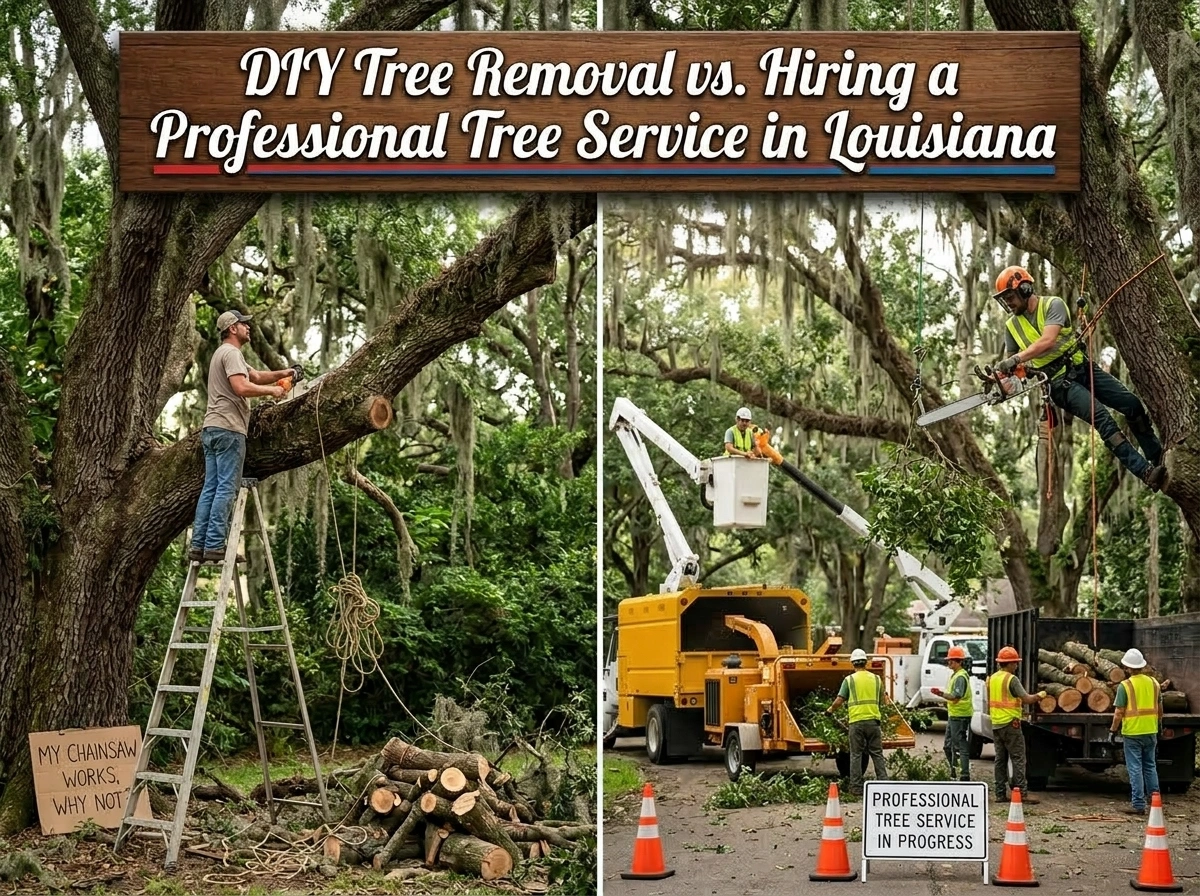
You look out the window at the same leaning oak that’s been bothering you all week. Grab the chainsaw, or make a call? For most Louisiana homeowners, the answer comes down to three things: tree size, condition, and what sits within reach if it falls wrong. A dead sapling in an open yard is a different job than a storm-battered pine leaning toward the garage. This guide covers when a professional tree service in Louisiana is the smarter call, what it costs, and where local weather changes the math.
What Actually Decides This: Size, Condition, or Location?
Most people size up a tree by how big it looks from the porch, but that’s not what matters. Trunk diameter tells you how much saw and force you’re dealing with, and a lean tells you whether the fall direction is predictable. What sits within the tree’s full height—a shed, a car, a power line—tells you what’s at stake if a cut goes wrong. Put those together, and the DIY vs. professional tree removal question answers itself, based on measurable tree removal risks rather than confidence.
When Removing a Tree moved youke Yourself Is a Reasonable Call
Plenty of trees on a typical Louisiana lot never need a crew. Young pines along a fence line, a dead crepe myrtle alone in the yard, and a sapling nobody planted on purpose. A capable homeowner can usually handle it when:
- The trunk is thin enough for a homeowner’s chainsaw, and it’s a young tree rather than a mature shade tree.
- There’s open ground on every side, enough that it can’t reach a house, shed, vehicle, or line if it tips.
- It stands straight, with healthy wood and no cracking, hollow spots, or dead limbs overhead.
- You’ve got a well-maintained saw, eye and ear protection, gloves, and some prior experience using them.
- There’s no fence line or property line question involved.
Even then, wear the gear and know your escape path first. DIY tree removal done in a hurry is how a simple job ends at the ER.
Warning Signs a Tree Removal Has Moved Out of DIY Territory
Certain conditions flip a tree from a weekend project into a job for a licensed tree service, no matter how handy you are with a saw.
Size, Lean, and Storm Damage
A taller, heavier tree carries far more force once falling, and that’s harder to control with hand tools alone. A lean usually means something underground has already given way—root damage or soil stress—not just growth toward the sun. Storm-cracked or wind-thrown trees carry that same unpredictability.
Distance From Your Home, Fence, Driveway, or Power Lines
Distance needs to be measured against the tree’s full height, not where the trunk sits. A tree thirty feet from the garage can still land on it once you factor in the canopy, and the same applies to fences, driveways, and parked vehicles. Power lines are their own category. Any tree with limbs close to a line belongs to the utility company or a certified crew.
Hidden Decay and Branches You Can’t Fully See
Rot doesn’t always show from the outside. A trunk can look solid while it’s hollow inside, and dead limbs can hang thirty feet up without catching your eye. A professional arborist checks for this using tools and training that a homeowner at ground level doesn’t have.
| Safety Tip: If a tree shows two or more of these signs at once, treat it as a professional job. That’s not overcaution. That’s how the risk adds up. |
Mistakes That Turn a DIY Removal Into an Emergency
Most DIY tree accidents don’t come from bad luck. They come from the same handful of mistakes, over and over.
- Misjudging the drop zone: assuming a tree lands where it’s cut, without accounting for wind or uneven canopy weight.
- Skipping the escape route: cutting without a clear path away from the fall line.
- Working alone: no one nearby if a saw kicks back or the tree shifts early.
- Getting too close to a line: treating careful cutting near power lines as safe, when a falling limb can be just as dangerous as the wire itself.
Tree removal safety comes down to training as much as equipment, and chainsaw injuries usually trace back to one of these habits.
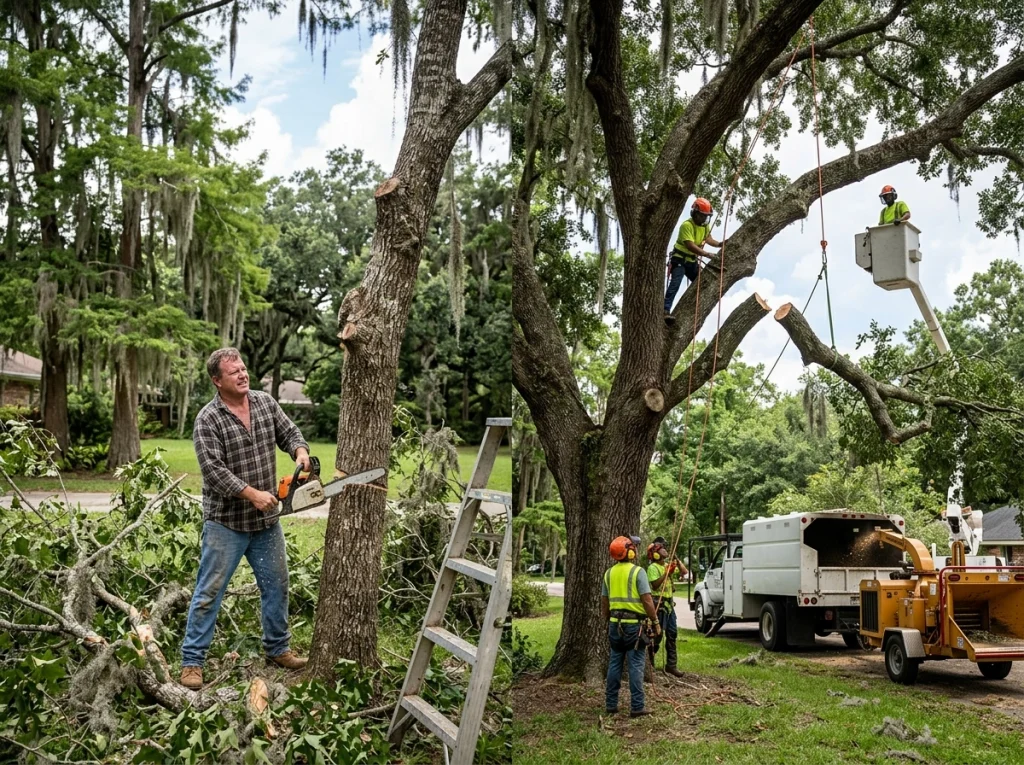
DIY vs. Professional Tree Removal: A Side-by-Side Look
Lined up next to each other, the trade-offs get easier to see. Neither option wins for every tree.
| Factor | DIY Removal | Professional Tree Service |
| Best suited for | Small, healthy trees in open space | Any size, condition, or location |
| Equipment needed | Homeowner chainsaw, basic safety gear | Rigging, bucket trucks, chippers, stump grinders |
| Experience required | Basic cutting skill | Trained, often licensed arborists |
| Near structures or power lines | Not safe | Handled with rigging and utility coordination |
| Time and effort | A full day of your own time | Usually done in hours |
| Cleanup and debris | You haul and dispose of it | Typically included |
| Stump handling | A separate project | Often available as an add-on |
| Liability if something goes wrong | You carry the risk | Covered by contractor insurance |
This doesn’t rule out DIY for every tree. It shows where the tradeoffs shift once structures, lines, or size enter the picture.
Factors That Influence Professional Tree Removal Costs
Pricing swings a lot from one job to the next. Small removals often run in the low hundreds of dollars, while large, hazardous, or storm-damaged jobs can climb into the thousands. Louisiana pricing follows the same logic; it depends on the tree in front of you, and a written estimate is the only real way to know your cost.
- Height, trunk diameter, and overall size.
- Whether the tree is dead, tilted, or damaged by a storm.
- How close it stands to a house, fence, driveway, or power line.
- How easy the site is to access.
- Whether stump grinding and debris hauling are part of the task.
| Pro Tip: Get more than one written estimate for anything beyond a small tree, and schedule non-emergency work before storm season fills up crews’ calendars. |
Why Louisiana’s Weather Raises the Stakes
Hurricane season leaves more than downed branches behind. A tree can survive high winds standing but come out with cracked limbs, damaged roots, or a lean that wasn’t there before, none of it obvious from the driveway. That’s part of why so many removal calls come in the weeks after a storm.
Heavy rain adds its own complication. Saturated soil loosens root systems, and a tree that looked stable in dry weather can shift once the ground turns soft. Heat and humidity make DIY cutting harder too, since fatigue sets in fast and tired hands are when chainsaw accidents happen. Permit and right-of-way rules can differ by parish and property type, so check with your local government or utility before cutting.
Quick Decision Checklist: DIY Job or Call a Pro?
Call a professional tree service if any of these apply to your tree:
- It’s taller than a single story, or the trunk is too thick to get your arms around.
- Any part of it could reach your house, garage, fence, driveway, or a vehicle.
- Branches sit near or touch a power line.
- It’s dead, hollow, cracked, or leaning.
- It took storm damage recently, or the ground has been soaked for days.
- You don’t have the tools, gear, or experience to control the fall.
Choosing a Licensed, Insured Tree Service in Louisiana
Ask for proof of state licensing along with liability insurance and workers’ compensation coverage. A written estimate should spell out what’s included, cleanup, hauling, and whether stump grinding is priced separately. A crew that’s worked through Louisiana storm seasons and knows the region’s tree species can judge risk better than one passing through, and a local tree removal company with a real track record is often worth more than the lowest unfamiliar bid.
Frequently Asked Questions
Can I remove a small tree myself?
Yes, if it’s small and healthy, standing in open space with nothing nearby it could reach. A professional becomes the safer call once it’s taller or sits near a structure or line.
When is tree removal too dangerous for DIY?
Once height, decay, storm damage, or a lean is involved, or the tree could reach a structure or power line, the job moves past what a homeowner can safely manage.
How much does professional tree removal cost in Louisiana?
It depends on the tree’s size, condition, and site access, plus whether cleanup or stump grinding is included. A free estimate is the only way to get an accurate number.
Does tree removal require a permit in Louisiana?
Sometimes. Rules vary by parish and property type, so check with your local government or utility office before cutting.
Can I remove a tree near a power line myself?
No. Work near an energized line belongs to the utility company or a certified crew, since contact through a falling limb can be just as dangerous as the wire itself.
Final Thoughts
Most of this comes down to the same three questions: how big is the tree, what shape is it in, and what’s close enough to get hit if it falls wrong. A small, healthy tree in open ground is often a fair project for a capable homeowner. A leaning, storm-damaged, or decayed tree near a house, fence, or power line is a different situation.
When a removal falls into that second category, Tree Time Elite Tree Care can take it from there. Our company is led by a Louisiana-licensed arborist with thirty years of hands-on experience, and every job starts with an estimate. We serve Shreveport, Bossier City, and the rest of Northwest Louisiana, with full cleanup and stump grinding. Call us now at (318) 470-5867 for services you can rely on.