
Professional tree removal in Louisiana involves far more than cutting a trunk into pieces and hauling it off the property. A qualified crew evaluates the tree, studies the surrounding property, and makes decisions about equipment and sequencing based on what they find. Power lines, fences, driveways, and root systems all shape how a removal actually proceeds. This guide covers the five stages involved in a typical job, the equipment choices behind them, and the local conditions that can change how the work gets done.
Assessing the Tree and the Property
A trunk can look sound from a distance and still have internal decay near the base or a crack where a major limb splits off. An arborist checks for these signs first, along with the direction a tree would fall without support and how far it leans. Height factors into the plan because it affects how much material must be removed and how difficult it may be to control sections during the work.
Attention then turns to what surrounds the tree. A fence line a few feet away, a shed sitting close to the canopy, or power lines running through the upper branches all influence how the job gets approached. Access varies by property. Some yards give a crew room to bring in equipment; others require everything to happen through a narrow side yard or over a low fence. A leaning tree may sometimes be managed with cabling or corrective pruning rather than complete removal. Its overall condition and location determine which option is appropriate before any cutting starts.
Planning and Preparing the Work Area
Assessing the tree’s condition only answers part of the question. The removal approach depends heavily on how much space is available and where the material can safely be brought down. That plan then leads directly into physical preparation of the site.
A controlled work zone gets established, vehicles and bystanders are kept clear of it, and landscaping, driveways, or fencing near the tree are protected before cutting begins. Utility lines running near the tree get accounted for at this stage, since their position can affect equipment choice and the order sections come down. Protecting the property isn’t a separate task bolted onto the schedule. It gets built into the plan from the start, alongside decisions about access and equipment.
Removing the Tree in Controlled Stages
Once preparation is complete, the crew works through the tree methodically rather than all at once. Upper branches typically come off first, reducing the tree’s overall weight and improving visibility before larger cuts are made. Larger limbs get addressed based on their size and what sits beneath or beside them, and the crew reassesses conditions as the canopy is reduced.
The trunk is handled according to available clearance. Where there’s open space, it can sometimes be brought down largely intact. Where a structure, fence, or landscaping sits too close, sections get removed piece by piece instead. The specific techniques used to control this process depend on training and equipment that go beyond what’s useful to describe here, but the underlying goal stays the same throughout: reduce risk with each cut and protect whatever surrounds the tree.
Handling the Trunk and Remaining Wood
Once the tree is down, larger trunk sections and heavy limbs still need to be broken into manageable pieces before they can be moved. Depending on the arrangement made with the homeowner, this wood may be hauled away, cut and stacked for firewood, or left in sections if that’s what’s requested. Smaller branches are often run through a chipper on site, which reduces the total volume that needs to be trucked out.
Access plays a role in how this stage unfolds. A property with a gate wide enough for a truck allows for straightforward hauling. A backyard tree with no direct vehicle access may require material to be carried or moved with smaller equipment before loading becomes possible.
Cleaning the Site and Addressing the Stump
A complete cleanup goes beyond the obvious pile of logs and branches. Smaller debris, bark, and wood chips scattered during removal need to be cleared too, particularly near flower beds or grass where leftover material can cause damage if left in place too long.
Stump grinding is often handled separately from tree removal. Some companies include grinding in the original scope of work, while others price it separately. Confirming this detail ahead of time avoids confusion later, since having a tree removed doesn’t automatically mean the remaining stump will be ground.
Choosing Equipment for the Job
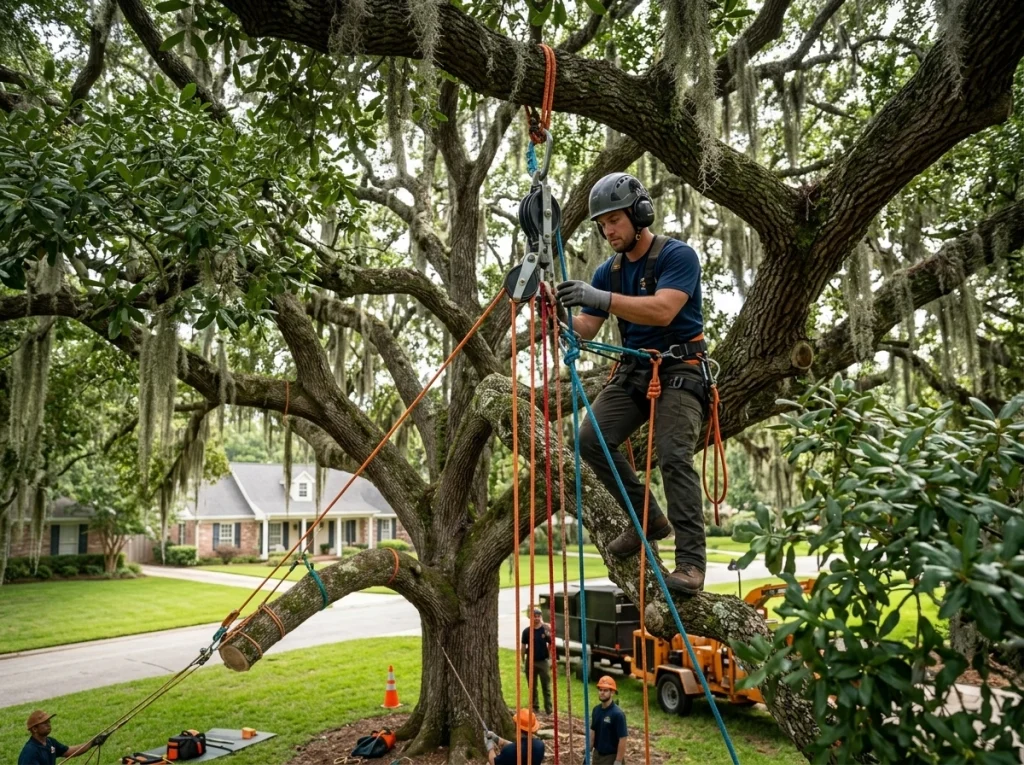
Equipment gets matched to the specific tree and property rather than applied the same way on every job. A straightforward backyard removal might only call for a chainsaw and standard protective gear. Mature trees on residential lots around Shreveport can affect where equipment is able to sit, particularly when their size and root spread limit access.
| Equipment | When It May Be Used | Why It Matters |
| Chainsaw | Cutting tree material during removal | Allows trained crews to work through sections methodically |
| Climbing equipment | Reaching parts of the tree that can’t be accessed from the ground | Provides access when the site doesn’t support work from below |
| Rigging equipment | Controlling material in restricted spaces | Helps manage pieces coming down near structures or landscaping |
| Crane | Certain large or difficult removals | Assists with heavy sections when site conditions require it |
| Safety gear | Every removal | Protects workers as conditions vary from tree to tree |
Tree height, condition, proximity to structures, and available space all factor into which combination actually gets used.
Louisiana Conditions Can Affect the Removal Approach
Weather plays a real role in how removal work gets planned in this part of the state. A tree can survive a storm without visibly falling and still carry internal stress that isn’t obvious from the ground, which is one reason storm-damaged trees are often worth having evaluated even when the damage looks minor.
Mature trees are found on many older residential lots around Shreveport and the surrounding area, and their size and root spread can limit where equipment is able to sit. Ground conditions after heavy rain can affect footing and equipment access for a period of time, though how long that lasts depends on the property and the weather that follows. Lot size varies significantly by neighborhood, and a tight urban lot presents different access challenges than a larger rural property. Requirements around tree removal can differ by parish or municipality, so it’s worth checking with a local provider about what applies to a specific address rather than assuming the same rule applies everywhere in the state.
Frequently Asked Questions About Professional Tree Removal
How long does professional tree removal take?
This depends on the tree’s size, condition, and how much access the crew has to work with. A straightforward job in an open yard might be finished in a few hours, while a large tree near a structure takes longer to plan and execute.
Can a tree close to my house be removed safely?
In many cases, yes, though it typically requires more detailed planning and sometimes specialized equipment to control how sections come down. Not every situation allows for the same approach, and the specific layout of the property determines what’s needed.
Does tree removal include stump grinding?
Not automatically. Some providers include stump work in the original estimate, while others treat it as an additional service. Confirming this before scheduling avoids surprises later.
What happens if a tree is near power lines?
Trees growing close to power lines require extra precautions and may require coordination with the utility company or qualified professionals trained for this type of work.
What happens to the tree after removal?
Branches are usually chipped on site. Larger logs get cut down further and are either hauled away or left for the homeowner, depending on what was arranged before the work began.
What Louisiana Homeowners Can Expect From Tree Time Elite
Removing a tree the right way comes down to a handful of things done in the right order: assessing the tree carefully, planning around the property, taking it down with control, and leaving the yard in better shape.
Tree Time Elite Tree Care is a family-owned company serving Shreveport and the surrounding Northwest Louisiana area, led by Kevin Lee, a Louisiana-licensed arborist with 30 years of experience. Our team provides tree removal, stump removal, and grinding to help property owners manage hazardous, unwanted, or storm-damaged trees. We offer free estimates and respond to emergencies when storm damage or a hazardous lean needs prompt attention.
For a professional assessment of a tree on your property, call us at (318) 470-5867 or email us at Treetimeelite@gmail.com.