
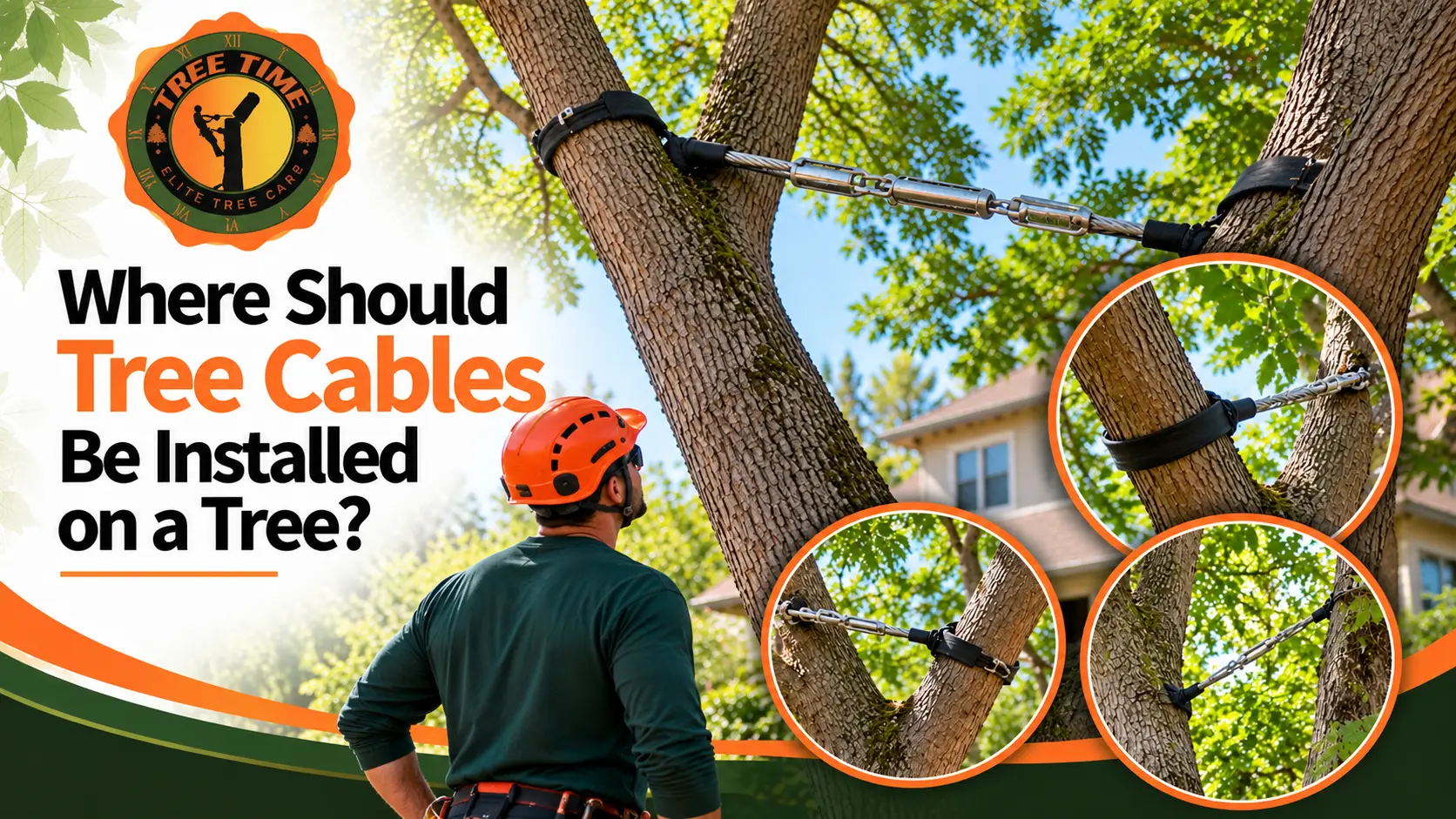
You know a cable can help a weak tree. Nobody explains where it actually goes. So where should tree cables be installed? In most trees, they run high in the upper crown between selected stems or major branches above the weak spot. The exact location depends on the tree’s structure and the weakness being supported. It also depends on the wood at each end and the cable system used. Height alone never makes a placement right.
Where Should Tree Cables Be Installed?
Cables usually sit in the upper crown and connect selected branches or stems above a structural weakness. Their job is to limit excessive movement at that weak point when wind loads the tree. The exact spot depends on the branch union being supported and the tree’s form. The attachment wood and the cabling system matter too.
Arborists start from a common rule of thumb. The cable goes roughly two-thirds of the distance from the union toward the ends of the branches. Industry tree care standards point to this same zone. Treat it as a starting point, not a fixed measurement for every tree.
Why Cable Installation Height Matters
Height controls leverage. A cable set high in the crown works on a long lever arm, so it resists the stems pulling apart with less strain on the hardware. Drop it too low, and the stems above still whip around while the anchors take a harder pull. Go too far out on a thin branch, and that slender wood may bend instead of holding the load.
Why Every Tree Needs an Individual Placement Plan
No two crowns are built alike. An arborist looks at the tree’s form and how the major branches are arranged. The weakness type matters, along with wood condition and the support goal. A tight V between two upright stems calls for different thinking than a long limb over a roof. The guideline gets the arborist into the right part of the tree. The tree decides the final spot.
How to Choose the Right Tree Cable Attachment Points
Attachment points matter as much as height. The cable is only as strong as the wood holding each end.
Selecting Sound Branches or Stems
Sound wood comes first. An arborist checks each candidate branch or stem for size and for signs of cracks or decay near the planned attachment point. The wood must carry the load the cable transfers in a storm. A branch sitting on its own weak union still makes a poor anchor. A cable does not repair the weak spot. It only helps limit how hard that spot gets worked.
Positioning Cables Across a Weak Branch Union
Think of the weak union as a hinge. The cable runs high above that hinge and connects the stems or branches that tend to spread apart. Wind pushes those parts away from each other, and the cable takes up part of that pull. So the union and the attachment points are two different places. How the cable lines up depends on how the stems lean and move.
When a Proposed Attachment Point Is Not Suitable
Some spots simply won’t work. Decay in the planned anchor zone can rule a location out. So can old storm damage or too little solid wood to hold hardware. The arborist may shift the cable to different branches or try another configuration. Sometimes no workable anchor exists, and cabling may not be the right answer.
How Cable Placement Changes With Tree Structure
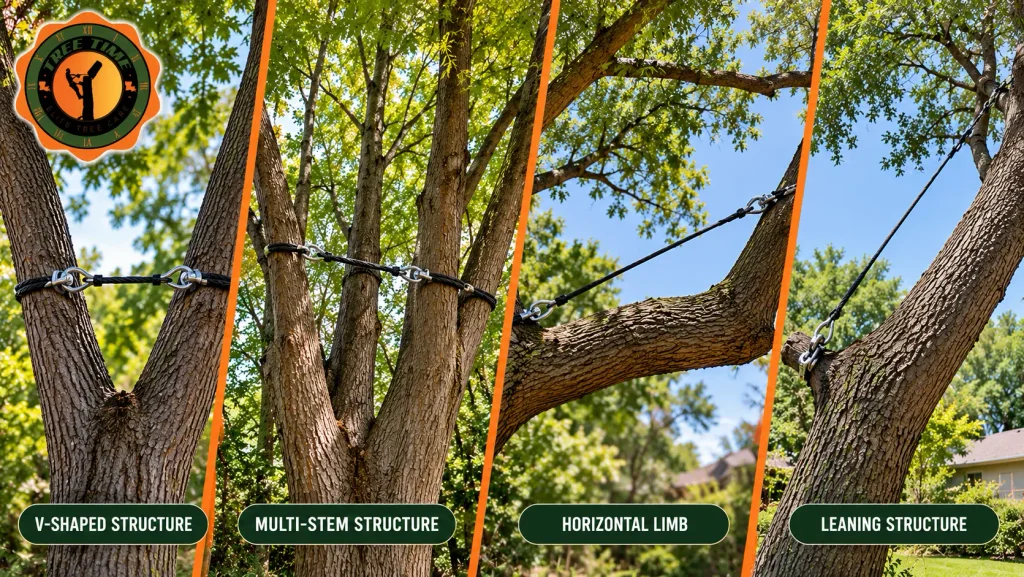
Tree shape changes the layout. Two leaders, five big stems, and one heavy limb each need a different setup.
Trees With Two Main Stems
Two-stem trees are the most familiar cabling job. A single cable often runs straight between the stems, high above the union where they meet. That direct link helps keep them from spreading too far apart in wind. Both anchors need sound wood. The cable also has to line up well between the stems, or it may not control the movement it targets.
Trees With Several Major Stems
Three or more structural stems change the math. Linking just two can leave the others free to swing and may shift stress somewhere new. Arborists sometimes connect the stems in a triangle so each ties to two others. Other trees need a different layout based on stem spacing and which unions need help.
Heavy or Extended Branches
Long, heavy limbs need another kind of help. The cable often runs from the limb up to the trunk or a stronger leader. The upper anchor sits above the limb so the cable shares part of its weight. That supporting wood has to handle the extra load. A cracked limb may need rigid support instead, and the difference between tree cabling and bracing as support methods comes down to how each handles that load.
What Should Arborists Consider Before Installing Tree Cabling Hardware?
Convenient spots fool people. A location that looks easy to reach is not automatically right.
Tree Growth and Hardware Clearance
Trees keep growing after the cable goes in. Hardware needs clearance from nearby branches so limbs don’t rub against it as they sway and thicken. The setup should leave room for natural movement. Crowding new growth can cause damage the tree never needed.
Cable Tension and the Intended Support
Tension has to match the purpose. Some systems go in fairly snug to restrict movement. Others are dynamic and allow normal sway before the cable starts working. Too much tension stresses the attachment points. The wrong setup leaves a cable that may not help when the tree needs it.
Choosing Appropriate Cable Hardware
Hardware should follow the job, not habit. Some systems use steel cable with anchors drilled through the wood. Others use synthetic rope that wraps around the limb with no drilling. The right choice depends on the tree, the support goal, and each attachment point.
Common Tree Cable Placement Mistakes to Avoid
Bad placement does more than waste money. It can weaken the support or pile fresh stress onto healthy parts of the tree.
- Picking a cable spot before anyone assesses the structural weakness
- Anchoring hardware in decayed or otherwise unsuitable wood
- Treating the two-thirds guideline as a rule that never bends
- Setting hardware where neighboring branches or future growth will interfere
- Using the wrong configuration or tension for the job
- Assuming a cable makes a structurally compromised tree safe
Most of these come from skipping the assessment. Placement should follow a close look at the actual tree and the needs of the system going in.
How Can You Tell Whether Tree Cable Placement Is Appropriate?
Looking up from the yard tells you a little. It cannot tell you whether a cable is doing the right job.
What a Homeowner Can Observe
Walk around the tree and look at the big picture. You can usually see how the major stems divide and whether a cable shows in the canopy. You might spot a branch rubbing against the hardware. Those details still can’t show whether the anchors are sound.
What an Arborist Must Assess
An arborist judges placement from the structure outward. That means checking the weakness the cable supports and the wood at each anchor. The cabling system and support goal matter too. A full tree cabling inspection covers these points in more depth.
Frequently Asked Questions
How High Should Tree Cables Be Installed?
Roughly two-thirds of the way from the weak union toward the branch ends is the common guideline. The actual height still depends on the union, the tree’s structure, and the cabling system.
Can Tree Cables Be Attached to Any Large Branch?
No. A big branch can still hide decay or a weak union of its own. Size says nothing about wood condition or whether that branch suits the support needed.
Should Tree Cables Be Installed by a Professional Arborist?
Yes. Placement depends on reading the tree’s structure and choosing the right hardware and method. The work happens high in the crown, where falls are a real hazard. Leave it to a trained professional.
Final Thoughts
Good cable placement comes down to the weakness being supported, sound attachment points, and the right height. The two-thirds guideline points to the right zone, but the tree sets the final answer.
Tree Time Elite Tree Care serves Bossier Parish and Northwest Louisiana. Owner Kevin Lee is a Louisiana-licensed arborist with 30 years of experience. He provides tree cabling and bracing across Northwest Louisiana. Worried about a fork or heavy limb? Call (318) 470-5867 for a free estimate. Kevin will tell you honestly whether cabling fits or another option makes more sense.