
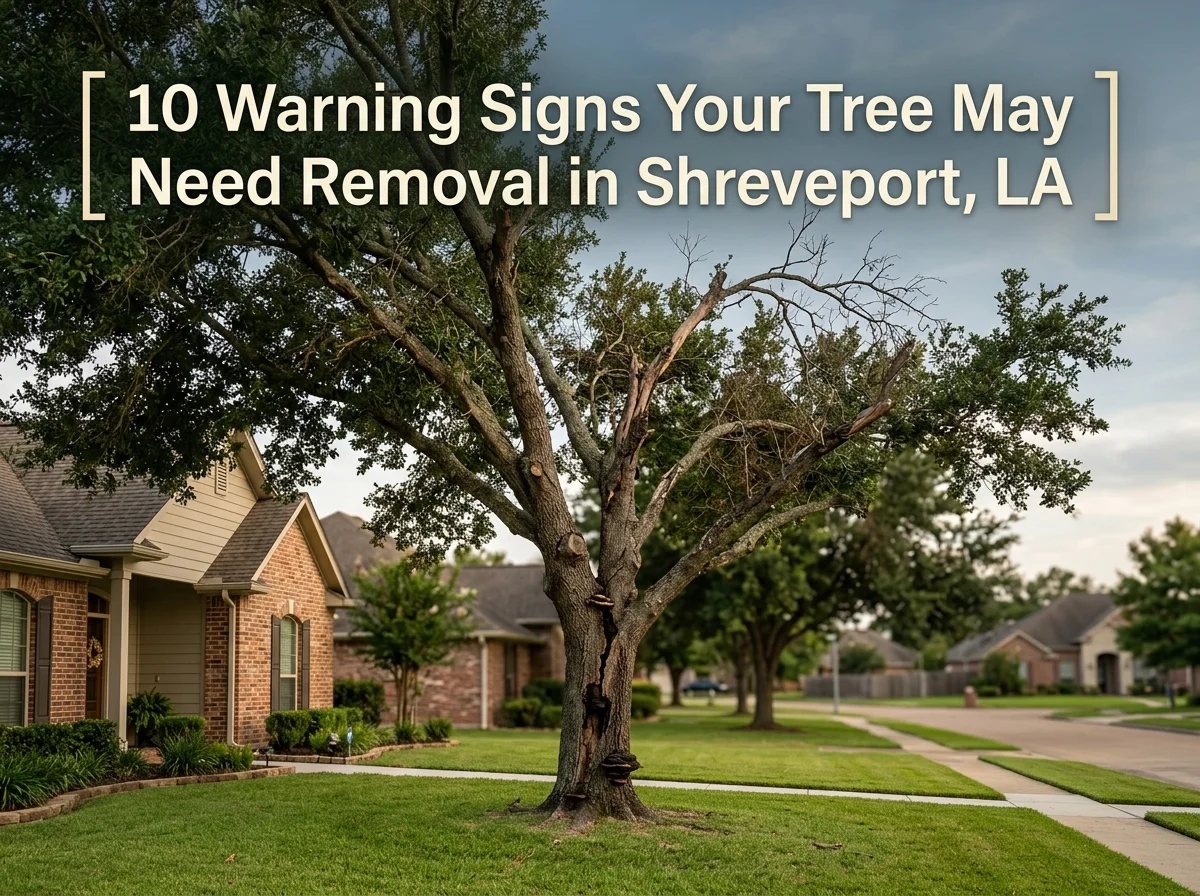
A healthy tree may appear healthy from afar but have serious issues in the trunk, roots, or large branches. When a tree is close to the house, driveway, vehicle, or power line, any other factors that could contribute to failure can be a problem, including deadwood, decay, root damage, and structural weakness.
The need for regular monitoring of trees is even more critical for residents of Shreveport since it gets approximately 51.3 inches of rain each year and has thunderstorms occurring about 57 days per year. Strong storms and rainfall can reveal weaknesses that were not apparent prior to the event.
If you notice any of the following signs that a tree needs to be removed in Shreveport, it is worth having the tree professionally assessed before the next major storm.
1. Large Sections of the Tree Are Dead
Do not assume that the removal of a tree is warranted if there are a few dead twigs. But if there are lots of dead branches around the canopy, it is a serious sign of decline.
Look for:
- Large branches with no leaves during the normal growing season
- Brittle branches that break easily
- Clusters of dead limbs along one side of the tree
- Major limbs that have lost their bark
- Branches that remain bare while nearby healthy branches are leafing out
Dead branches can fall without warning. The risk increases if big limbs are overhead on your roof, driveway, sidewalk, or other place where people congregate. Pruning may be enough when the problem is limited. If the majority of the foliage is dead or the trunk is also dying, the removal might be a safer choice.
2. The Tree Has a New or Increasing Lean
Not every leaning tree is dangerous. Some trees naturally lean as they grow and can stay sturdy for many years.
The concern is a new lean or a lean that is clearly on the rise. This can be a sign of root damage, soil shifting, structural issues, or instability. Inspect the base of the tree for exposed roots, lifted soil, cracks in the ground, or spaces between the ground and roots. These symptoms may indicate a root system change.
After a rain or storm, if the tree is leaning, it requires immediate action, particularly if it is big or near a building.
3. There Are Deep Cracks or Splits in the Trunk
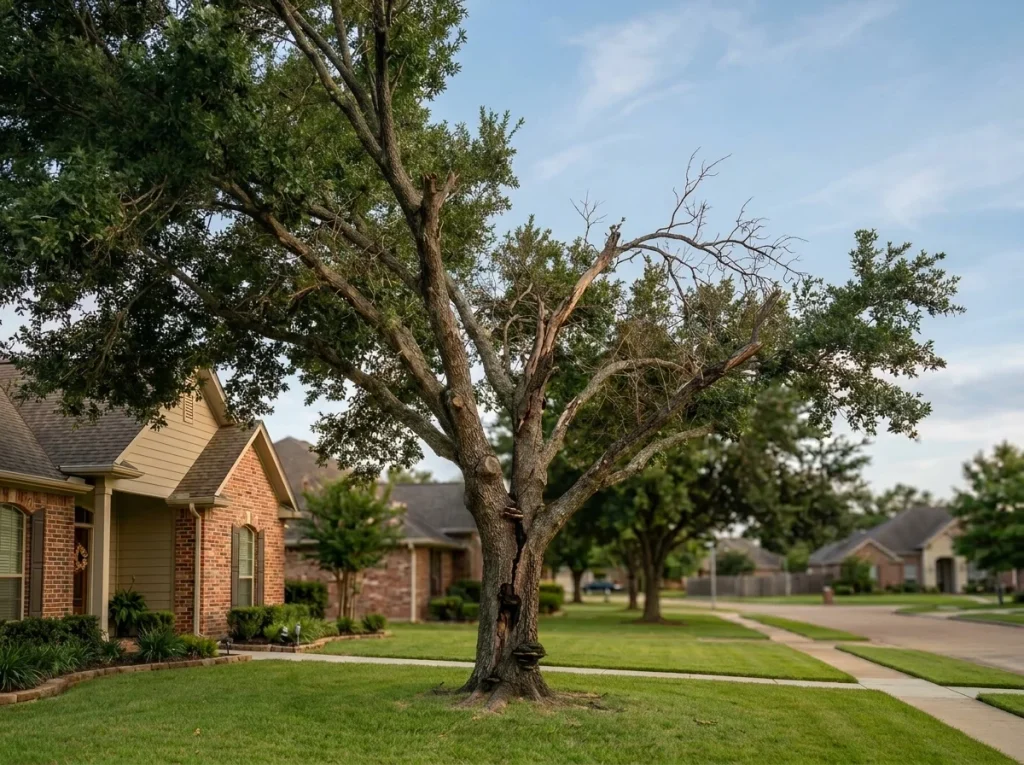
The trunk serves as the tree’s primary support system. A deep crack can weaken that support, particularly when the damage extends through a major section of the trunk. Vertical cracks, split trunks, and large cavities do not all have the same level of risk. A professional tree inspection can establish the amount of sound wood that is left in a tree and whether it can still support the tree.
A crack is more concerning when it:
- Continues through a major branch union
- Appears to be widening
- Is accompanied by a visible lean
- Develops after storm damage
- Occurs near the base of the tree
Do not assume that a tree is safe simply because it is still standing. Structural damage can become worse over time.
4. You See Fungal Growth Around the Base
Fungal growth, including mushrooms, around a tree does not necessarily indicate that the tree needs to be removed. However, certain fungal activity can indicate that decay is affecting the roots or lower trunk.
The big issue is what is going on below the surface. A tree can still be leafing out while the internal wood rot is weakening the tree’s structure. Pay close attention when fungal growth appears alongside other warning signs, such as trunk cavities, peeling bark, dead branches, or root instability.
A professional evaluation can be used to establish if the fungus is causing a problem with the tree structure or if it is just growing on nearby organic material.
5. The Trunk Is Hollow or Has Large Areas of Decay
Holes or cavities in trees don’t always indicate tree removal. Internal decay of trees can be tolerated. But if decay is extensive, there will be less sound wood on which a tree can stand. When the structure is still there but cannot safely bear the canopy and major limbs, the risk of failure increases.
Symptoms include large trunk cavities, soft or crumbling wood, loose bark, deep cracks around decayed areas, and areas that seem hollow.
The position of the decay is important. Decay at the base can compromise the overall stability of the tree; decay in a large branch can pose a fall hazard on the limb.
6. Major Roots Are Damaged or Decaying
Tree roots provide both water and structural support. A large percentage of root loss can impact tree stability and health. Root problems can occur after construction, trenching, soil modification, flooding, vehicle traffic, or disease. Homeowners may not notice the damage right away, as most roots are hidden in the ground.
Possible signs include:
| Root Problem | Possible Warning Sign |
| Root decay | Fungal growth or instability |
| Construction damage | Decline after nearby excavation |
| Root failure | New lean or lifted soil |
| Loss of root function | Thin canopy or branch dieback |
When roots are badly affected, pruning back the canopy may not resolve the problem. The tree may still decline or be unstable.
7. Large Branches Are Cracked, Hanging, or Weak
If a branch is hanging, it might seem like a pruning problem, but it is important to consider the size and location of the branch. It is possible to remove a small, damaged branch safely. A large split limb above a roof, driveway, or power line is a different situation.
Stay away from a hanging branch or don’t try to cut it off. The branch might be strained, and the load may move suddenly while being removed. In Shreveport, where thunderstorms occur regularly, weak branches can fail during high winds or heavy rainfall. The National Weather Service reports an average of 57 thunderstorm days each year for the Shreveport area.
8. The Tree Has Severe Storm Damage
Trees are not always beyond rescue because of storm damage. In some cases, branches can be pruned, and some trees will recover from moderate canopy damage.
If a major trunk split or root movement, a sudden lean, or loss of large structural branches occurs due to a storm, then the situation gets more serious. Once a big storm is over, make sure to be safe before going to inspect the property. Check for new root growth, limbs drooping over, cracks that were not there before, and limbs that are on top of buildings or structures.
If a damaged tree is near power lines, do not approach the area. Contact the appropriate utility provider or a qualified professional.
9. The Tree Is Growing Too Close to a Structure or Utility Line
A close-to-the-house tree does not necessarily pose a threat. A tree with structural problems is much more serious if there is a target under the tree. Consider what could happen if a major branch or the entire tree falls. Potential targets include:
- Homes and garages
- Vehicles
- Fences
- Driveways
- Sidewalks
- Neighboring property
- Utility lines
A close-to-the-house tree does not necessarily pose a threat. A tree with structural problems is much more serious if there is a target under the tree. In Shreveport, the arborists who conduct their work within the city limits must hold an annual city permit in addition to being licensed by the state. The city has a permit system that requires proof of a Louisiana arborist license.
10. The Tree Is Clearly Dying and Cannot Recover
Trees can experience temporary stress from drought, transplanting, pests, or storm damage. A tree that’s declining isn’t always beyond saving. However, removal may become necessary when there is widespread canopy loss, extensive decay, severe root damage, and little evidence that the tree can recover.
A professional assessment can help to distinguish a treatable tree health issue from tree decline. The aim should not be to eliminate all the unhealthy trees. However, if it can be successfully saved and protected with pruning, treatment, or other management, then this may be the more appropriate choice.
The City of Shreveport also points out that the hazard area, tree loss, and the potential to save the tree are factors to consider in tree maintenance decisions.
Can a Damaged Tree Be Saved Instead of Removed?
Yes, sometimes you can. Usually, people think about removing a tree when it’s obviously hazardous, badly damaged, or simply too far gone to bounce back. But if the damage only affects a few branches and the tree’s main structure is still solid, you might have some options. Pruning or specific treatments can help.
A professional should always take a look first, considering things like:
Tree condition: Is the problem limited or widespread?
Structural stability: Can the trunk and roots continue to support the tree?
Location: What could the tree damage if it fails?
Recovery potential: Can proper pruning or treatment improve the tree’s condition?
Remember, nobody wants to remove a healthy or salvageable tree for no reason. At the same time, keeping a dangerous one around just puts people and property at risk.
When Should You Schedule a Tree Inspection?
Don’t wait until disaster strikes. If you notice your tree leaning, big patches of deadwood, trunk cracks, fungus growing, root exposure, or serious storm damage, it’s time to call in an expert. Have large trees checked out if they’re close to your home, garage, or any area with lots of activity.
Shreveport’s climate adds another reason to stay proactive. With more than 51 inches of average annual rainfall, frequent thunderstorms, and a growing season of roughly 230 to 240 days across northwest Louisiana, trees experience long periods of active growth and repeated weather exposure.
Tree Time Elite Tree Care can help homeowners evaluate concerning tree conditions and determine whether pruning, treatment, or removal is the appropriate next step.
Frequently Asked Questions
How can I tell if a tree is unsafe?
Look for numerous lifeless branches, deep cracks in the trunk, rot, damaged roots, sudden leaning, or limbs dangling dangerously. The risk depends on what the tree could hit if it falls. A professional inspection can evaluate both the tree’s condition and potential targets.
Do leaning trees always have to be removed?
No. Some trees lean naturally and stay strong for years. But if a tree suddenly leans or the lean gets worse, especially alongside exposed roots or storm damage, you need to get it checked.
Can a tree with a hollow trunk be saved?
Sometimes, yes. Hollow spots don’t always spell disaster. What matters is how much strong wood remains, where the decay is, and whether the tree’s structure is still solid. An expert can tell you if it’s worth saving.
Should I remove a tree that is close to my house?
Not necessarily. A healthy, structurally sound tree can sometimes remain near a structure. Removal may be considered when the tree has serious defects, significant decay, root instability, or other conditions that increase the likelihood of failure.
Who is responsible for removing a hazardous tree in Shreveport?
Responsibility can depend on where the tree is located and the circumstances. The City of Shreveport states that dead or diseased trees on private property that constitute a hazard may be subject to city action, while property owners can be required to address hazardous trees at their expense.
Final Thoughts: Do Not Wait for a Dangerous Tree to Fail
Do not wait until things get really bad. A single dead branch or a bit of loose bark isn’t always an emergency. But if your tree shows several warning signs, major damage, lots of rot, or shifty roots, it’s time to act. Regular check-ups help you catch issues early, especially before a heavy storm pushes things over the edge.
For Shreveport homeowners, regular inspections can help identify problems before heavy rain or storms place additional stress on an already weakened tree. Tree Time Elite Tree Care can assess the condition of a tree and help determine whether professional pruning, ongoing care, or safe removal is the right solution.