A tree needs cabling or bracing when it has a specific structural weakness, such as a cracked limb or two stems joined at a poor angle, and the rest of the tree is healthy enough to be worth keeping. Size, age, a lean, or an odd shape doesn’t define it on its own. Plenty of big, oddly shaped trees stand for decades with no hardware.
Sorting out whether a tree needs cabling or bracing in Shreveport LA, starts with something a homeowner noticed: a crack after a storm, a limb that looks too heavy, or a fork in the trunk that seems tight. Support is one possible answer. Pruning and removal are others, and an arborist who inspects the tree can say which one fits.
What Tree Conditions May Call for Structural Support?
Four things drive the call: the kind of weakness, where it sits, the tree’s overall health, and what stands below.
Weak or Narrow Branch Unions
Look at where a branch meets the trunk. A narrow angle tends to make a weaker attachment, and bark can end up enclosed between branch and trunk. That enclosed bark is called included bark. It doesn’t doom a union, but it deserves a closer look.
Cracks, Splits, or Separation
Cracks grab attention, and not every one earns it. A hairline split in a small branch is nothing like a crack through a limb near the trunk. Cracks that widen or move in the wind climb the list, as do cracked limbs near a major union. A crack alone doesn’t settle the question.
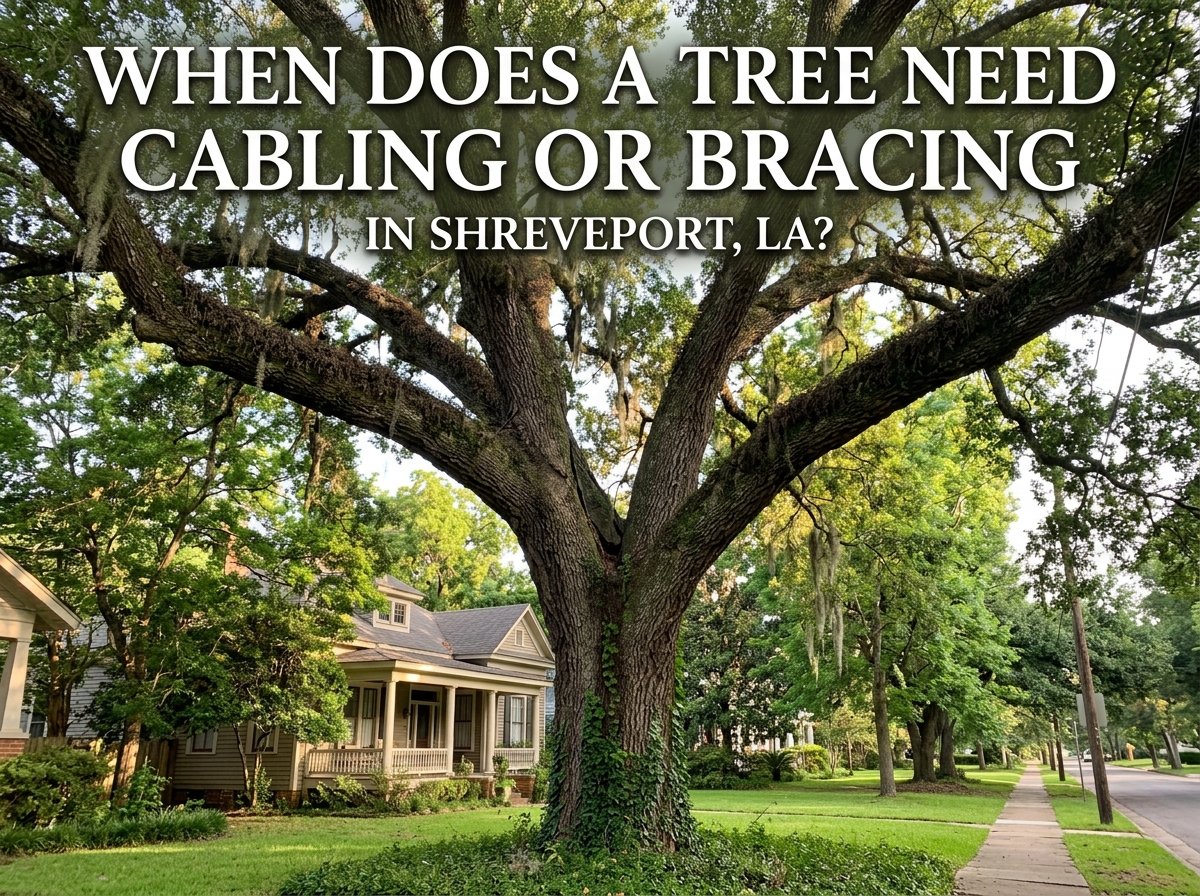
Co-Dominant Stems and Heavy Limbs
Co-dominant stems are two stems of roughly equal size growing from one point on the tree trunk. Many are sound. Trouble starts when they sit tight together with bark enclosed between them. Heavy lateral branches—frequently seen on local Shreveport mature oaks and pecans—act like levers on their attachment points, so position counts as much as size.
Previous Damage or Developing Structural Problems
A limb that split in an earlier storm can look healed and still be compromised underneath. Watch for change: a gap wider than last spring, fresh cracking beside an old wound, a union that moves more than it used to.
Which Signs Should a Shreveport Homeowner Have Checked?
A homeowner doesn’t need to diagnose anything. Any of these is worth a call:
- A major limb has a visible crack.
- Two large stems meet at a questionable union.
- Bark appears trapped between co-dominant stems.
- A heavy branch extends over a home or commonly used area.
- A previously damaged union appears to be separating.
- A new structural concern appears after severe weather.
Each one justifies an inspection, not an automatic recommendation for cabling or bracing.
When Is Cabling More Appropriate Than Bracing?
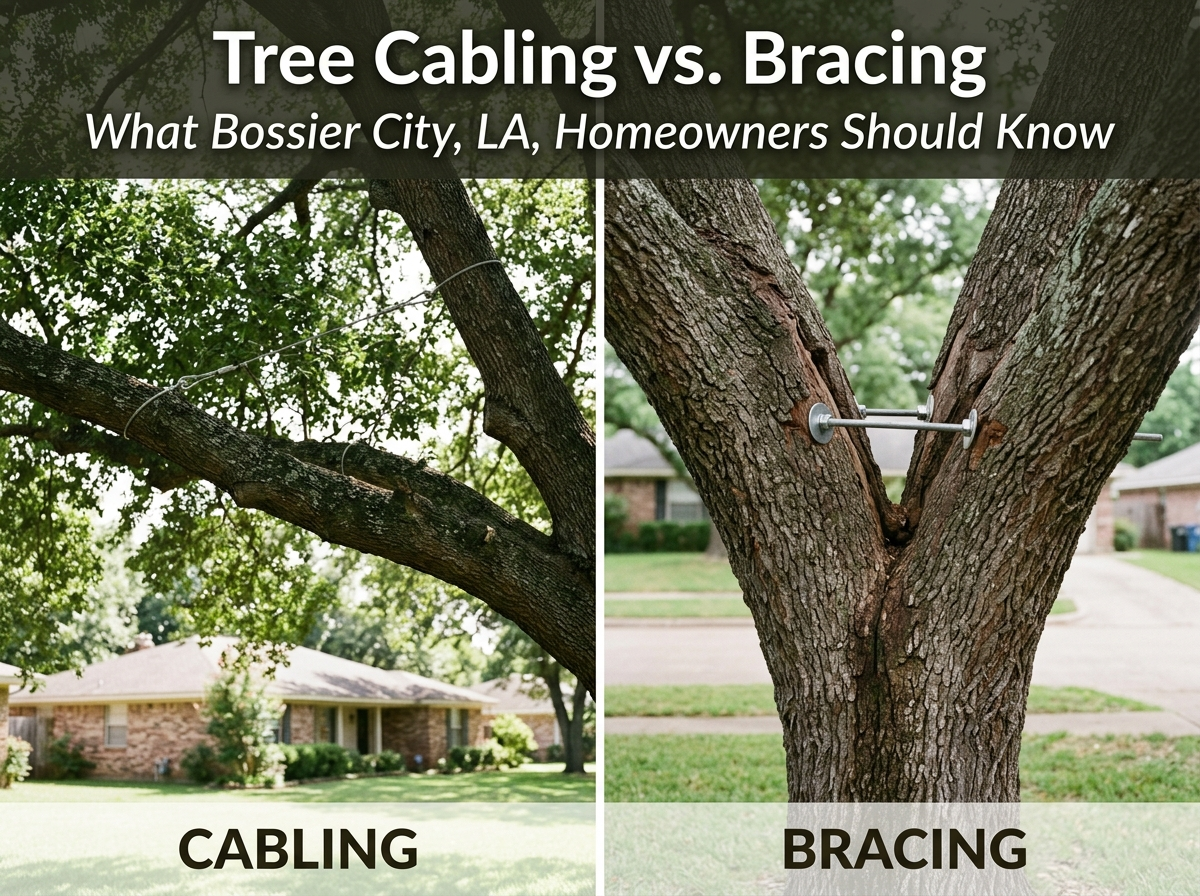
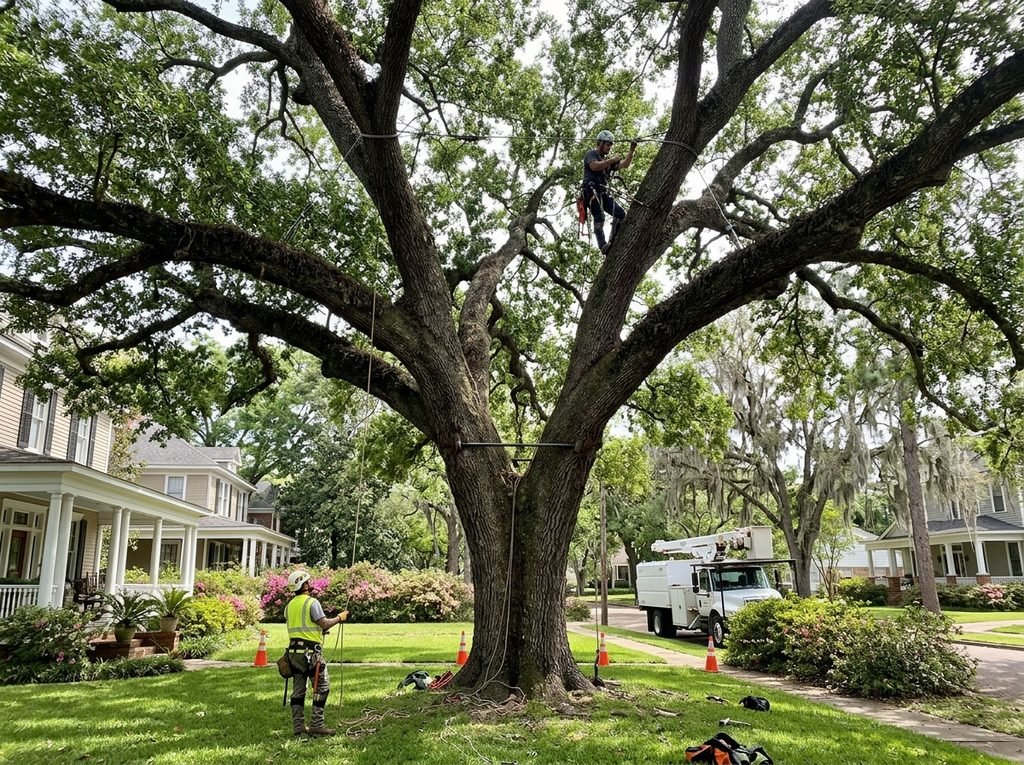
Cabling suits a weakness that involves more than one part of the tree, such as two co-dominant stems joined at a tight union, or a long limb that moves far more than its neighbors. The cable provides supplemental support between those parts and limits how far they can move apart, which eases strain on the weak attachment. Bracing fits better when the problem is a crack or split at one spot. In both cases, the surrounding wood has to be sound, since cables do nothing for decay or failing roots.
When Does Bracing Make More Sense?
Bracing fits a problem concentrated in one place, such as a crack or split through a limb or trunk, or a union that has started to separate. Where a cable limits movement between parts of the tree, a brace rod gives rigid supplemental support right at the weak spot. It only works if the wood around the defect is sound enough to hold the rod, which is one reason tree bracing in Shreveport starts with an inspection.
What Should an Arborist Look for Before Recommending Support?
A tree safety assessment looks past the crack or weak limb that prompted the call. Overall health comes first, since a declining tree is a poor candidate for hardware. The trunk and major limbs are checked for decay, and the structural defects are weighed for location and whether they are getting worse.
The crown shape and what lies below, such as a house or driveway, complete the arborist assessment of tree stability and determine whether the tree is worth keeping. A good arborist tree inspection in Shreveport ends with a clear explanation of what was found and why.
When Is Cabling or Bracing Not the Right Answer?
Cables and rods only help a tree with solid wood for them to anchor to. Severe decay, extensive structural failure, serious root problems, advanced decline, and defects that can’t reasonably be reduced leave little sound wood to hold anything. Where a tree is failing in several places, removal may be the safer call.
Can Pruning Be Used Instead of Cabling or Bracing?
Often it’s part of the answer, sometimes all of it. Structural pruning, selective weight reduction, or simple monitoring may be enough for some trees. Cabling, bracing, or both follow when those fall short, and removal when risk can’t reasonably be reduced.
What Should You Do If You Notice a Structural Problem?
- Don’t climb the tree or try to install support yourself.
- Keep people and vehicles away from an obviously unstable area.
- Take photos from a safe position if useful.
- Arrange a professional tree inspection.
- Ask what the structural problem is and why a particular treatment is being recommended.
What Should Homeowners Look At Before Deciding on Tree Support?
| What You Notice | What It Could Point To | What an Arborist May Evaluate |
| Crack near a major branch union | Structural weakness | Crack location, union condition, remaining sound wood |
| Two large stems growing from one point | Co-dominant structure | Included bark, attachment strength, and stem relationship |
| Heavy limb extending over a structure | Increased loading at the attachment | Limb weight, union condition, target below |
| Splitting or separation at a union | Developing structural failure | Extent of separation and tree stability |
| Structural defect in an otherwise healthy mature tree | Possible support candidate | Overall health, defect severity, site risk |
Frequently Asked Questions
What are the signs a tree needs cabling?
Look for two or more healthy stems or limbs sharing a weak union, such as co-dominant stems with bark trapped between them, or a heavy limb that moves a lot in the wind. A crack by itself doesn’t settle it. An arborist needs to inspect the tree before cabling is recommended.
What are the signs a tree needs bracing?
The usual sign is a crack or split running through a limb or trunk, or a union that has started to pull apart. The wood around the problem has to be solid enough to hold a rod. If decay has hollowed it out, bracing is usually off the table.
Can a tree with included bark be supported?
Sometimes. It depends on the tree’s overall health, how tight the union is, and whether there is cracking or decay. A healthy tree with a sound but tight union may be a good candidate for cabling. Rot or an open split at the union usually calls for a different plan.
Is cabling or bracing better for a split tree?
Neither is better by default. Bracing deals with the split itself, while cabling limits how far the parts on either side can move apart. Some trees get one, some get both, and some are better off with pruning or removal. How deep the split runs and where it sits usually decide.
Can cabling prevent a tree from falling?
No. Cabling can ease strain on a weak union, but it can’t promise the tree will stay standing. It does nothing for root problems or decay elsewhere in the tree, and a limb can still fail somewhere the hardware doesn’t reach. Supported trees need rechecking over time.
How Often Should a Supported Tree Be Inspected?
There’s no single schedule that fits every tree. Supported trees keep growing, and their condition changes, so they need to be checked on a regular basis. How often depends on the health of the tree, the type of support in place, and how the area underneath is used.
How Can Tree Time Elite Tree Care Help With Structural Tree Problems in Shreveport?
A crack, weak union, split, or pair of co-dominant stems doesn’t automatically mean a tree has to come down. Some can be kept with support, others with monitoring alone.
Tree Time Elite Tree Care provides tree cabling, bracing, and professional tree inspection for Shreveport and Northwest Louisiana. Kevin Lee is a Louisiana-licensed arborist with 30 years of professional tree service experience. An assessment determines whether cabling, bracing, or removal fits that particular tree.
To have a questionable union or crack looked at, contact Tree Time Elite Tree Care for an assessment or estimate.