
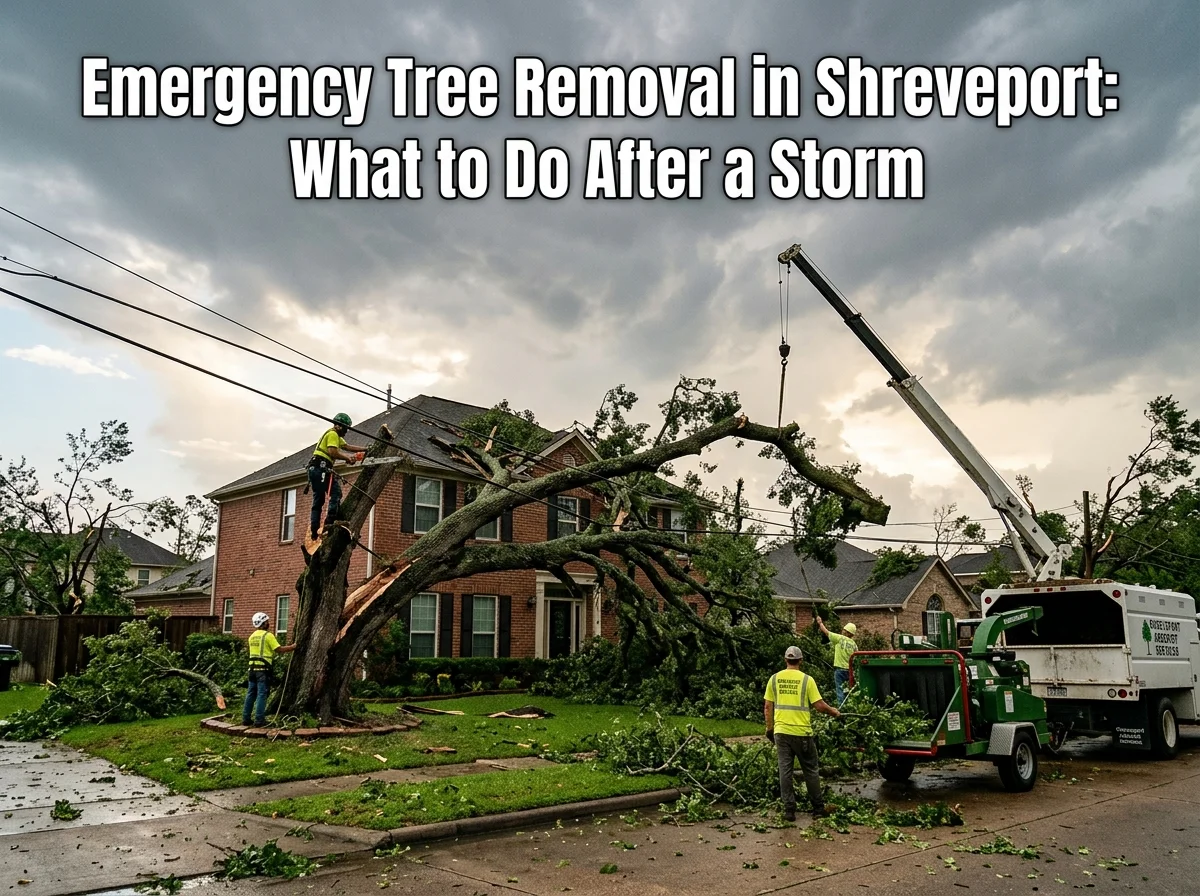
It is the morning after a thunderstorm, and you step outside to find a pecan tree leaning from the soaked soil toward your roofline. This is a familiar scene in Shreveport during storm season, when high winds and heavy rain can leave yards filled with fallen limbs and unstable trunks. If you are standing in your yard wondering what to do and looking for emergency tree removal in Shreveport, this guide explains what to check after a storm and what to avoid while the area is still unsafe.
Immediate Safety Steps After the Storm
Wind doesn’t have to be blowing for a damaged tree to be dangerous. A trunk that’s already cracked, or a limb barely hanging on, can shift or drop without warning once the storm has technically passed. Give the situation time before you step outside to take a closer look.
- Stay indoors until wind and lightning have fully passed.
- Look at the yard from a window or another safe location first.
- Keep children and pets away from the damaged area.
- Note anything touching the house, driveway, or a power line
- Avoid walking through debris until you know what’s underneath it.
Is It a Tree Emergency? How to Tell
Not every broken branch means you need someone out there today. A few leaves down and a snapped twig or two is normal after a windy afternoon. What actually signals trouble is a handful of specific physical warning signs, and once you know what to look for, sorting out real danger from routine mess gets a lot easier.
- A cracked or split trunk
- Roots that are visibly lifted or exposed at the base
- A tree resting against the house, garage, or roofline
- A new or sharply increased lean
- Large broken limbs caught in the upper canopy
- Any part of the tree touching a power line
| Situation | Emergency or Routine? |
| Tree fully or partially fallen on a structure | Emergency |
| Tree touching or resting on a power line | Emergency |
| Split trunk or major limb hanging loose | Emergency |
| Tree leaning into driveway or blocking an exit | Emergency |
| Minor twigs or leaf litter | Routine cleanup |
| Old healed damage with no new lean or cracking | Routine, scheduled inspection when convenient |
Power Lines and Downed Trees: Safety Comes First
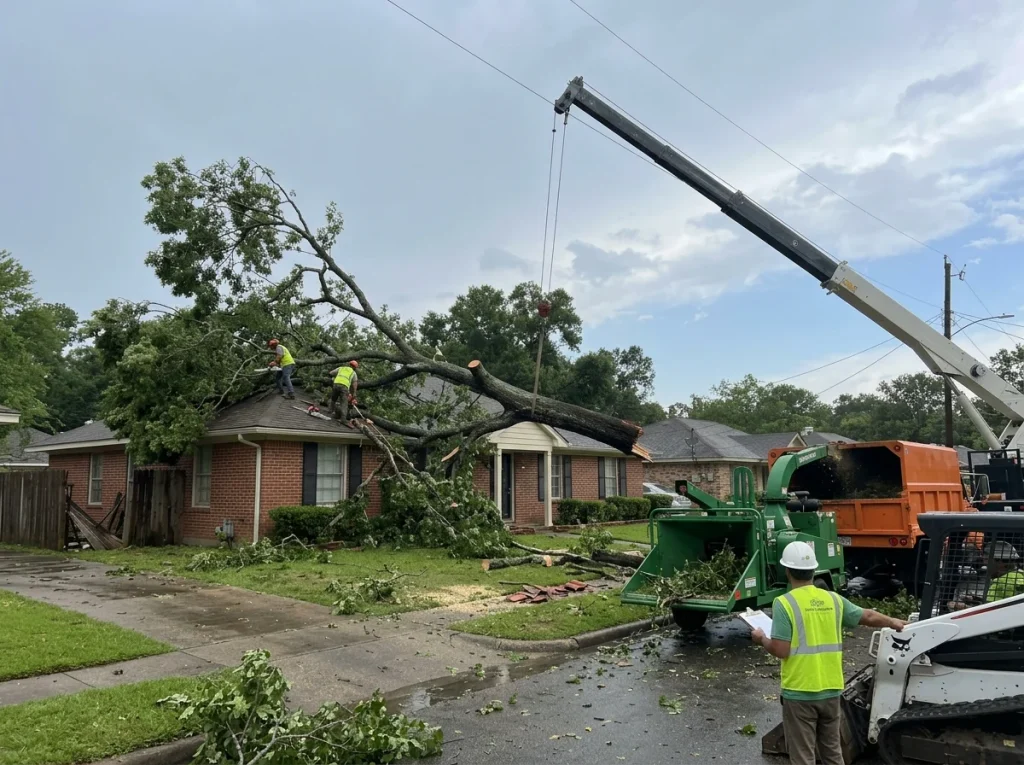
The tree or branch that has come into contact with an electric power line is a hazard to watch more carefully than any other you’ll see after a storm. Whether the line is in good shape or the power remains on in the vicinity doesn’t matter. Currents can flow from a tree to an electric line in ways that might not be readily apparent upon first inspection.
Stay away, stay far away from kids and pets, and contact your utility company before anyone approaches that area of the yard.
| Warning: Treat any tree or branch touching a power line as dangerous, whether or not it looks damaged. Keep a safe distance, keep others away, and report it to your utility provider right away. |
What Not to Do While You Wait for Help
Storm cleanup goes wrong fast when someone tries to handle a hazard they aren’t equipped for. A few habits show up again and again in the aftermath of bad weather, and they’re worth avoiding entirely.
- Don’t climb on, under, or near a leaning tree.
- Don’t cut branches that are under tension from a partial fall.
- Don’t attempt any work near a tree touching a power line.
- Don’t park vehicles or leave belongings under damaged limbs.
- Don’t assume a standing tree is stable just because it hasn’t fallen.
Documenting the Damage and Understanding Insurance
After the initial threat has been addressed, document the situation in photographs while it is still fresh. Wide shots of the entire area are helpful, as are close-ups of the trunk or where the tree actually failed. If the tree came into contact with the house, garage, or driveway, capture that as well; as soon as cleanup begins, it’s harder to capture that clearly.
Tree damage insurance coverage is heavily influenced by the type of insurance policy and the conditions of the storm. In some situations, there is coverage; in some, there is no coverage; and in some, there is no single rule. The best way to know is to contact your insurance company directly with photos in hand.
When to Call a Professional
The answer is not as straightforward as you might think: it depends on how badly the tree is damaged and does not necessarily mean that a tree will not survive if you make repairs on your own. Whether or not the tree is actually unstable, how close to the house or power line it is, whether or not the roots or trunk are actually damaged, and whether or not it is blocking a driveway or an exit that needs to be cleared all play a role.
Emergency response is different from a scheduled trim or routine removal. The equipment that is brought on site is designed to work on trees under tension or already partway down, not a simple planned cutback; workers make assessments of the hazard before touching anything. The first goal is to remove the hazard and clean up later if necessary.
- On-site assessment to identify the hazard and how the tree is under tension.
- Securing the area before any equipment is used.
- Controlled removal of the hazardous section first.
- Cleanup once the immediate danger is gone.
| Pro Tip: After major storms, check that any tree company you hire carries current liability insurance. Storm season tends to draw in inexperienced or uninsured operators looking for quick work, so a little verification up front goes a long way. |
Frequently Asked Questions
How urgent is tree removal after a storm?
It depends on the tree, not the calendar. Distance from the house or a power line, and whether it’s blocking access, all matter more than how many hours have passed since the storm.
Can a storm-damaged tree be saved instead of removed?
Sometimes. Limited branch or canopy damage can often be pruned back and monitored over the following months. A split trunk or major root disturbance is a different story and usually points toward removal.
Can a tree look fine but still be unsafe after a storm?
Yes, and this trips up a lot of homeowners. Movement in the root plate or cracking inside the trunk isn’t always visible from the ground, which is exactly why a closer assessment can uncover problems a quick glance misses.
Does emergency tree removal include stump grinding and debris cleanup?
Usually not automatically. Emergency work is focused on getting the hazard down and the area safe. Stump grinding and full debris hauling are often handled as a separate step once the immediate danger is gone.
Will homeowners insurance cover storm-related tree removal?
It depends on your specific policy and the details of what happened. Rather than assuming either way, call your insurer directly and walk them through the situation before you make any decisions.
Get Emergency Help From Tree Time Elite Tree Care
A fallen tree or damaged limbs can leave you with a mess that needs attention fast. Tree Time Elite Tree Care helps Shreveport homeowners deal with storm-damaged trees and other immediate hazards. If you’re not sure what needs to happen next, reach out and describe what happened. The right next step can then be figured out for your property.